COZUMEL
Mexico
1 (888) 692-5115
24/7 Toll Free USA & Canada
+52 998 268 1054
WhatsApp & Mexican Number
Mexico
24/7 Toll Free USA & Canada
WhatsApp & Mexican Number

Pomacanthus paru
The French Angelfish is one of Cozumel’s most recognizable reef residents, often seen cruising calmly along coral walls and sponge-covered reefs, usually alone or in pairs. Its bold dark body, bright yellow accents, and graceful swimming style make it a favorite among divers and snorkelers. Curious but cautious, it is often easy to observe as it moves methodically across the reef in search of food.
Pomacanthus paru
The French Angelfish is one of Cozumel’s most recognizable reef residents, often seen cruising calmly along coral walls and sponge-covered reefs, usually alone or in pairs. Its bold dark body, bright yellow accents, and graceful swimming style make it a favorite among divers and snorkelers. Curious but cautious, it is often easy to observe as it moves methodically across the reef in search of food.

Cherub Anggelfish
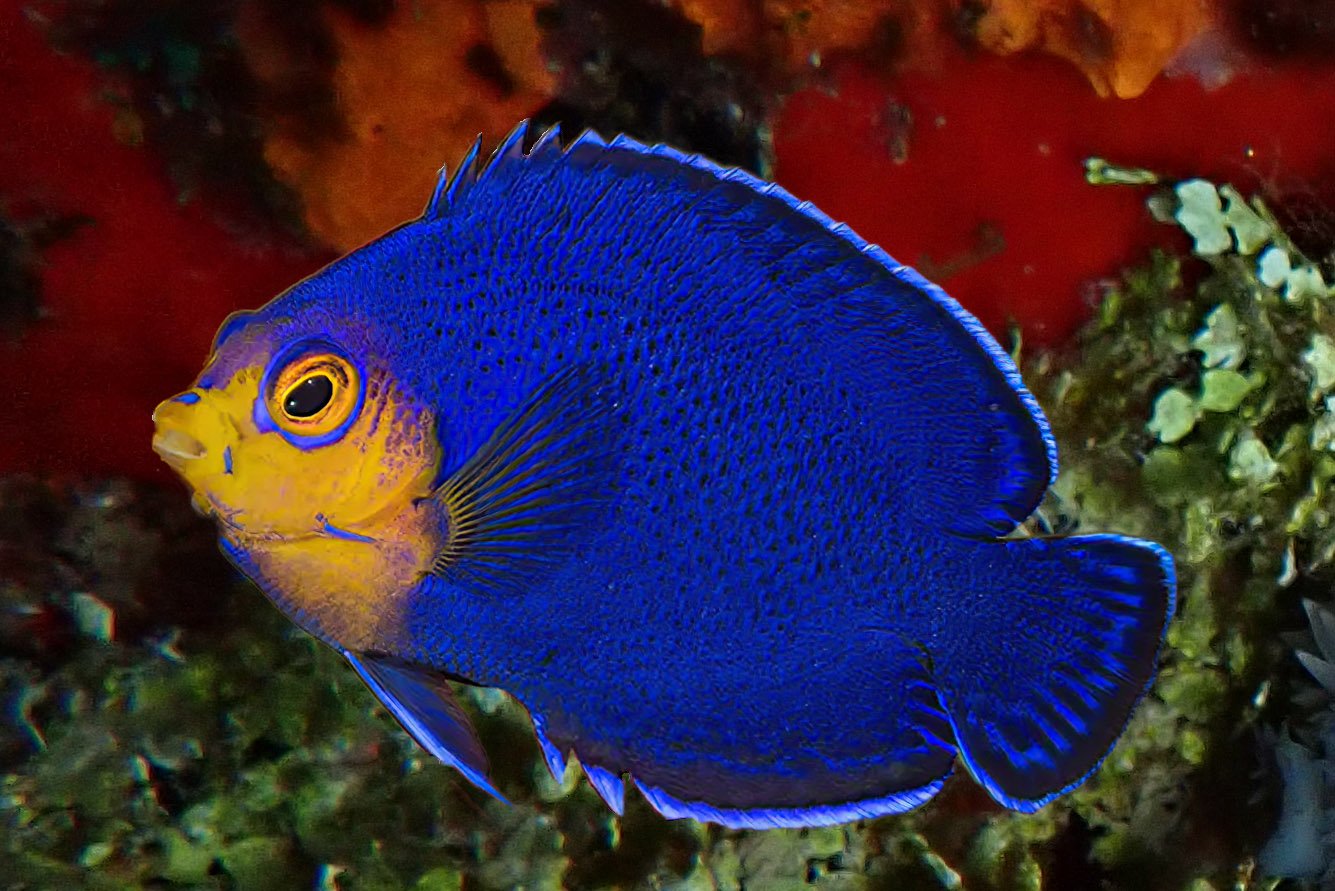
The Cherub Angelfish is a tiny but colorful reef fish found around Cozumel, usually close to coral heads, rocky crevices, and other sheltered reef structure. Its deep blue to purple body, bright orange face, and vivid blue markings make it easy to recognize despite its very small size. Cherub Angelfish are active and often stay close to cover, darting between cracks while feeding on algae and small encrusting organisms.
COMMON NAME: Cherub Angelfish
SIZE: Up to 3 in (8 cm)
COMMON SIZE: Around 2–2.5 in (5–6 cm)
LIFESPAN: Around 5–7 years in captivity; wild lifespan is not well established
DIET: Mainly algae, with small invertebrates and encrusting organisms
IUCN STATUS: Least Concern (LC)
DEPTH: About 15–250 ft (5–75 m)
HABITAT: Coral reefs, rocky reefs, crevices, and rubble areas
RANGE: Western Atlantic & Caribbean, including Florida, the Bahamas, Gulf of Mexico, and Caribbean
BEHAVIOR: Usually solitary, in pairs, or in small social groups; stays close to shelter and can be territorial
MAXIMUM WEIGHT: 20 grams
IDENTIFICATION: Tiny deep blue to purple body with a bright orange-yellow face and electric-blue edging on the fins.
MATING: A dominant male may mate with several females within a small territory or social group.
SPAWNING: Spawning typically occurs around dusk, when a pair rises into the water column and releases eggs and sperm.
PARENTAL CARE: None; the tiny pelagic eggs drift with the plankton and develop away from the reef.
Kingdom: Animalia
Phylum: Chordata
Class: Actinopterygii
Order: Acanthuriformes
Family: Pomacanthidae
Genus: Centropyge
Species: C. argi
TINY BUT TERRITORIAL: Cherub Angelfish may be only a few centimeters long, but they can aggressively defend their favorite patch of reef against much larger fish.
DWARF ANGEL: They belong to the dwarf angelfish genus Centropyge and are the smallest angelfish found around Cozumel.
HAREM LIFESTYLE: Cherub Angelfish can live in small social groups where one dominant male associates with several females.
SEX CHANGE: Like many dwarf angelfish, they are protogynous hermaphrodites—females can change into males if the dominant male disappears.
REEF GRAZERS: They spend much of the day picking algae and tiny organisms from reef surfaces, helping keep small patches of rock and coral structure grazed.
HARD TO SPOT: They often stay very close to cover and can vanish into the reef in a second, so divers may swim past them without ever noticing.
BIG PERSONALITY, SMALL BODY: Their aggressive behavior is completely out of proportion to their size, which is one reason aquarists and divers find them so memorable.